

There is a place in the American West where the ground breathes. Where 10,000 geothermal features hiss, pop, and erupt across a caldera the size of Rhode Island. Where wolves hunt elk at dawn in valleys so wide the horizon disappears. Most people who visit Yellowstone see perhaps ten percent of it. This guide is for the other ninety.
Yellowstone sits atop one of the most powerful volcanic hotspots on Earth. The caldera, roughly 34 by 45 miles, is the collapsed remnant of a supervolcano that last erupted 640,000 years ago. That molten energy is why the park has more geysers than every other country on the planet combined. It is also why visiting Yellowstone without understanding its geology is a bit like visiting the Louvre with your eyes half-closed.
This guide covers the classic icons, yes. But its real value is in what most travel sites skip: the backcountry geysers reachable only by multi-day hike, the microbes that turn hot springs into living rainbows, the park roads at 6 AM before any crowds arrive, the precise seasonal windows that change everything, and the 2026 fee changes that international travelers need to know before they book.
Essential Info2026 Entrance Fees and What Changed
Yellowstone's entry pricing changed significantly at the start of 2026. The Interior Department introduced a $100 nonresident surcharge on international visitors to eleven of America's most popular national parks, including Yellowstone. This is in addition to the standard entry fee and applies to anyone aged 16 or older entering from outside the United States.
| Pass Type | Cost | Valid For |
|---|---|---|
| 7-Day Vehicle Pass (domestic) | $35 | 7 consecutive days |
| International Visitor Surcharge (16+) | +$100 per person | Per entry, from Jan 1, 2026 |
| America the Beautiful Annual Pass | $80 (standard) | 12 months, all NPS fee sites |
| Annual Interagency Pass (new pricing) | $250 | 12 months, unlimited NPS + federal sites |
| Per-Person Entry (on foot / bicycle, 16+) | $20 | 7 consecutive days |
| Children under 16 | Free | All ages |
Revenue from the surcharge is earmarked for park infrastructure and maintenance. Rangers are now conducting more active verification at all five park entrances. Arrive with printed or digital proof of your pass. Spontaneous entry without documentation can result in delays or denied entry, especially at the West Entrance, which remains the busiest gate with known summer queues exceeding one hour during peak morning hours.
PlanningThe Best Time to Visit Yellowstone (Honest Breakdown)
Four million people visit Yellowstone every year. Roughly 63 percent of them arrive in June, July, and August. That means if you can shift your trip by even three weeks in either direction, your experience will be categorically different: shorter queues at thermal basins, wildlife that has not been habituated to daily crowds, and campground spots actually available without booking a year in advance.
| Season | Crowd Level | Wildlife Highlights | Conditions |
|---|---|---|---|
| April to May | Low to moderate | Newborn bison calves, bear emergence from dens, migrating birds | Snow possible on higher roads; some facilities open mid-April |
| June to August | Very high | Most wildlife active; wolves visible in Lamar | Warm days (60-80F), strong afternoon thunderstorms |
| September to October | Moderate | Elk rut in September, grizzlies hyperphagia feeding, golden larches | Crisp mornings, first frost by late October |
| November to March | Very low | Wolves more visible on snow, bison in thermal areas, otters | Many roads closed; snowcoach or snowmobile access only to some areas |

The geothermal landscape of Yellowstone viewed from above, where steam vents and hot springs color the earth in extraordinary patterns.
Icon, RethoughtOld Faithful: Beyond the Famous Eruption
Old Faithful earns its name. It erupts roughly every 60 to 110 minutes, shooting boiling water between 100 and 185 feet in the air for 1.5 to 5 minutes per show. But the geyser itself is just one element of what the Upper Geyser Basin offers. Most visitors see the eruption and immediately drive away. That is a significant mistake.
The Upper Geyser Basin contains the highest concentration of geysers on Earth. Within a two-mile radius of Old Faithful, you will find Grand Geyser (which erupts every 7 to 15 hours in spectacular 200-foot bursts lasting up to 12 minutes), Beehive Geyser (unpredictable but exceptional), Castle Geyser (the oldest geyser in the basin, likely 5,000 to 50,000 years old), and Morning Glory Pool, a vivid hot spring whose colors have shifted from deep blue to green and yellow over decades because visitors threw in coins and debris that insulated the edges.
The Observation Point Trail is a 1-mile climb above the geyser basin offering a bird's-eye view of Old Faithful and the surrounding thermal field. The trail sees a fraction of the boardwalk crowd. From the top, eruptions look completely different. You see the steam column rise through the pines, the scale of the basin laid out below, and no queue of shoulders in your frame.

Old Faithful in full eruption. Rangers at the visitor center can predict eruption times to within a 10-minute window based on the duration of the previous eruption.
Living ColorGrand Prismatic Spring: How to Actually See It
Grand Prismatic Spring is the third largest hot spring in the world and the largest in North America, measuring 370 feet across and 121 feet deep. Its colors are not dyed or digitally enhanced in photos. They are real, produced by thermophilic microorganisms (heat-loving bacteria and archaea) that form dense mats of orange, red, yellow, and green at the cooler edges of the spring, where temperatures range from 131 to 149 degrees Fahrenheit. The deep blue center is too hot (188F) for microbial life, so the water there is mineral-pure and reflects the sky.
There is a widespread misconception that the boardwalk in the Midway Geyser Basin provides the best view. It does not. From the boardwalk, you are essentially looking at one edge of the spring from ground level. The iconic overhead photograph that appears on every poster and phone wallpaper is taken from the Grand Prismatic Spring Overlook, reached via a short but steep trail off the Fairy Falls Trailhead parking area.
The Restless EarthNorris Geyser Basin: Yellowstone's Hottest and Most Dynamic
Norris Geyser Basin does not have a single famous icon. What it has is rawness. It is the oldest, hottest, and most geologically active geyser basin in the park, with ground temperatures at some points reaching 459 degrees Fahrenheit just a few feet below the surface. The basin changes visibly year to year, sometimes season to season, as hydrothermal activity shifts underground plumbing.
Steamboat Geyser at Norris holds the record for the world's tallest active geyser, with major eruptions reaching up to 300 feet. It is unpredictable by nature, sometimes going dormant for years then erupting dozens of times in a season. Between 2018 and 2020, it erupted more times than in any previous recorded period. When it blows during a major event, the eruption can last 10 to 40 minutes and the water discharge is violent enough to flood the parking lot. Checking current eruption predictions at the Norris Visitor Center before spending time in the basin is strongly advised.
The Back Basin loop at Norris is a 1.5-mile trail through a dense hydrothermal landscape with features like Echinus Geyser (whose acidic water has a pH close to vinegar), the Porcelain Basin overlook, and Pearl Geyser. On an overcast morning, when steam from dozens of vents rolls across the path, Norris feels genuinely primordial.
America's SerengetiLamar Valley: The Art of Watching Wildlife
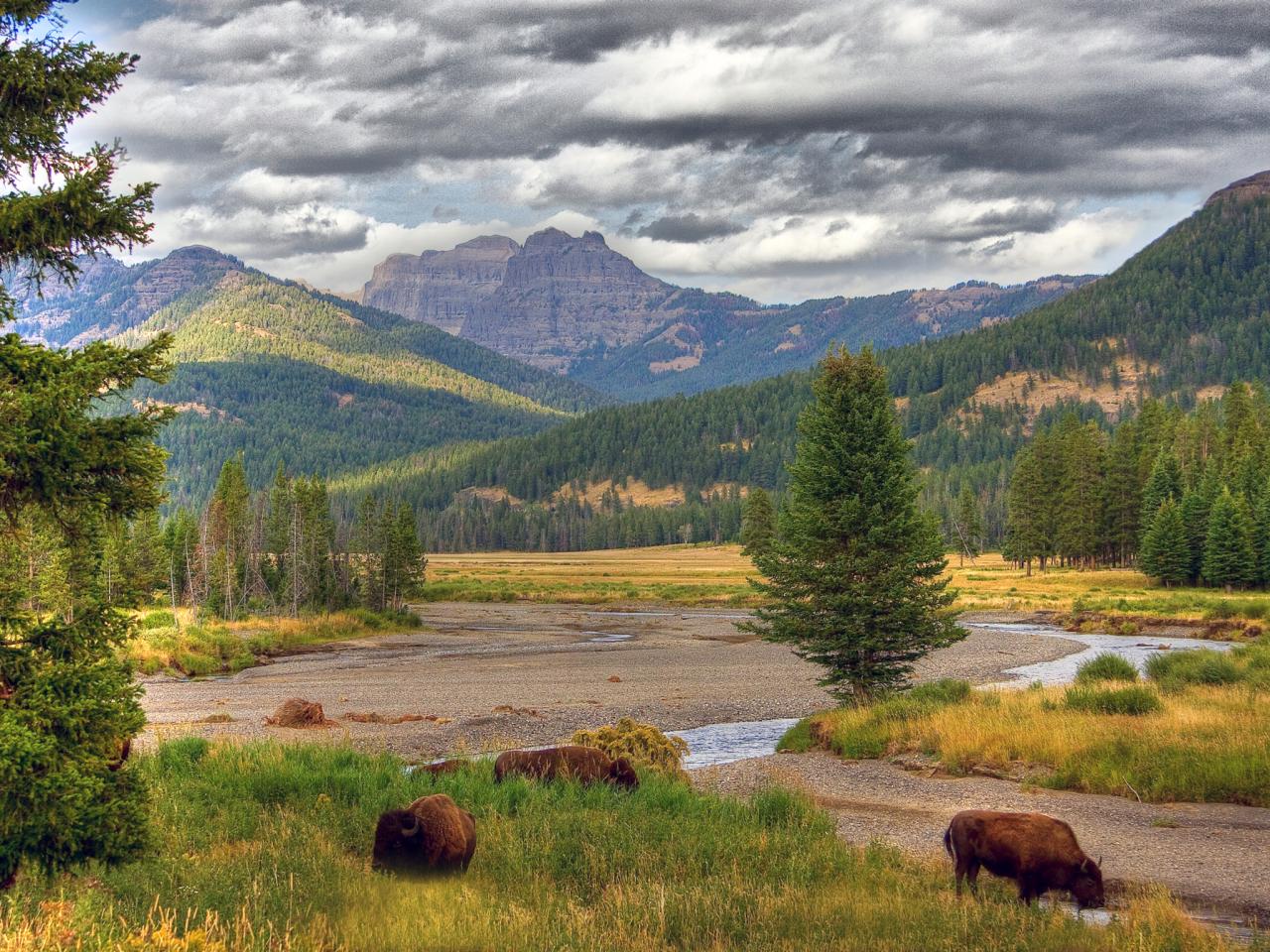
Lamar Valley in the northeastern corner of the park. At dawn, the valley floor belongs entirely to the animals.
Lamar Valley is a wide, river-threaded glacial valley in the northeast corner of the park that functions as a wildlife corridor unlike anywhere else in the continental United States. Biologists call it America's Serengeti. Bison herds of hundreds move through the valley floor. Pronghorn, the fastest land animal in the Western Hemisphere, graze in the sage flats. Grizzly bears emerge from the tree line at dusk to forage for roots and ground squirrels. And wolves, reintroduced to Yellowstone in 1995 after a 70-year absence, have established several packs in and around the valley.
Watching wolves in Lamar Valley is one of the great wildlife experiences available anywhere on Earth. But it requires patience and correct timing. The best strategy: arrive before sunrise. Park at a pullout with a long sightline across the valley floor. Bring or rent a spotting scope (the Yellowstone Forever Institute rents equipment). The Lamar Canyon Pack and the Junction Butte Pack are most frequently sighted. Wolf watchers often coordinate sightings through social media groups and local guide services. Your eyes alone will not spot a wolf half a mile away in dim light. A 20-60x spotting scope is the minimum effective tool.
Carved by Fire and WaterGrand Canyon of the Yellowstone
The Grand Canyon of the Yellowstone is 20 miles long, up to 1,200 feet deep, and colored in every shade of yellow, orange, pink, and red. Those colors are not rock layers. They are hydrothermal alteration, the same chemical process that drives the park's geysers slowly transforming the rhyolite canyon walls into iron oxide hues over thousands of years. The Yellowstone River, fed by snowmelt from the Absaroka Range, carved this canyon after the rhyolite was weakened by geothermal heat.
The Lower Falls, dropping 308 feet, is almost exactly twice the height of Niagara Falls. Most visitors see it from Artist Point on the South Rim, which is genuinely spectacular. But the view from the end of the North Rim's Uncle Tom's Trail, a steep staircase descending 328 steps to a platform close to the base of the falls, is viscerally different. The roar of the water at that proximity makes the whole platform vibrate.

The Lower Falls of the Yellowstone River at 308 feet is nearly twice the height of Niagara Falls. The canyon walls glow in iron oxide yellows and oranges.
Mineral TerracesMammoth Hot Springs: Where the Earth Builds Sculptures
Mammoth Hot Springs operates on a completely different geological principle than the geyser basins. Here, hot water travels through limestone, dissolving calcium carbonate as it rises, then deposits it as travertine when it reaches the surface. The result is a constantly evolving series of terraced formations, white and cream-colored, vaguely resembling a frozen waterfall or the inside of a cave turned outside.
The word to understand at Mammoth is dynamic. Features that were active and dramatic five years ago may be completely dry today. New ones emerge. The boardwalk system is adjusted regularly to follow where the water currently flows. Canary Spring, Palette Spring, and Minerva Terrace are usually the most active, but checking with rangers on arrival about which formations are currently steaming will tell you where to spend your time.
Mammoth is also where the park's administrative headquarters is located, and where a large herd of elk tends to congregate year-round, often resting on the town green and steps of the old Fort Yellowstone buildings. In September during the rut, bull elk weighing up to 700 pounds are frequently seen less than 50 feet from the road. This is not a zoo: maintain the required 25-yard distance.
The Quiet ValleyHayden Valley at Different Hours
Hayden Valley is the park's other great wildlife corridor, located in the central portion of Yellowstone between the Grand Canyon and Yellowstone Lake. Unlike Lamar Valley, which is long and linear, Hayden is a broad, open bowl of grasslands and the Yellowstone River, surrounded by rolling hills of lodgepole pine. Bison herds often number in the hundreds here. Grizzly bears are reliably seen in spring and fall when they come to the valley floor to forage.
What most visitors miss: Hayden Valley at night. On a clear summer night, far from any town, the Milky Way core is visible overhead in a way that urban-raised visitors often describe as genuinely disorienting. The park has almost no light pollution in its interior. Hayden Valley's broad sky with minimal tree obstruction makes it one of the best stargazing locations in the Greater Yellowstone Ecosystem.
Off the Boardwalk9 Hidden Gems Most Visitors Never Find
1. Shoshone Geyser Basin
Shoshone Lake is the largest backcountry lake in the Lower 48 not reachable by any road. On its western shore sits Shoshone Geyser Basin, a thermal field with features including Gourd Spring, Minute Man Geyser, and Taurus Geyser, all of which you will likely have entirely to yourself. Reaching it requires an 8.5-mile hike from the Lone Star Geyser trailhead or a non-motorized boat crossing from Lewis Lake. Lone Star Geyser itself, an hour's walk from the Old Faithful area on a flat trail, erupts every three hours and has been watched by perhaps one percent of the people who see Old Faithful that day.
2. Firehole River Swimming Hole
The Firehole River is geothermally warmed to temperatures 10 to 20 degrees higher than any other river in the park, making it paradoxically one of the stranger trout fisheries on Earth and one of the only places where swimming is permitted in Yellowstone's thermal waters. The designated swimming area is along Firehole Canyon Drive south of Madison Junction. On a warm June afternoon, locals treat it like a neighborhood swimming hole. It is almost never crowded. Water temperature runs roughly 80 degrees Fahrenheit. Bring sandals, as the riverbed is rocky.
3. Harlequin Lake
This 0.5-mile trail near Madison Junction leads to a quiet lake ringed by lodgepole pines. It is one of the few easy, flat, short walks in the park that almost no one knows about. The lake is particularly good for spotting waterfowl including the harlequin duck for which it is named, as well as common goldeneye and ring-necked ducks in spring and fall. It functions as a decompression walk for those who have been driving all day and want something gentle before sunset.
4. The Purple Mountain Trail
This unpopular trail near Madison Junction winds through lodgepole forest to a broad summit with a wide view over the geyser basins to the south. The trailhead sees almost no traffic compared to nearby attractions. The 6-mile round trip gains about 1,500 feet of elevation. From the top on a clear morning, you can see steam columns rising from a dozen thermal areas simultaneously spread across the plateau below.
5. Bechler Region (Cascade Corner)
The southwestern corner of Yellowstone, accessible only from Idaho via Cave Falls Road, is known among backcountry hikers as Cascade Corner for its extraordinary concentration of waterfalls. Union Falls at 250 feet is Yellowstone's second highest waterfall and sees a tiny fraction of the visitors who crowd the Lower Falls. The access road begins 26 miles outside Ashton, Idaho. This region also contains the Ferris Fork hot springs, reachable on a 13-mile hike to reservation-only backcountry campsites beside a warm, crystal-clear river. It is among the most remote and magnificent experiences in the entire park system.
6. Firehole Lake Drive
This 3-mile one-way road off the Grand Loop Road between Madison and Old Faithful is routinely skipped by visitors following standard itineraries. It passes Great Fountain Geyser, which erupts predictably every 10 to 14 hours in multi-tiered cascades that many consider visually more impressive than Old Faithful, White Dome Geyser (a tall, narrow cone geyser of unusual shape), and the serene Fountain Lake. Eruption predictions for Great Fountain are posted at the Madison Information Station.
7. Observation Point Above Old Faithful
The 1-mile trail that climbs above the Upper Geyser Basin to Observation Point sees perhaps 5 percent of the foot traffic on the Old Faithful boardwalk below. From this overlook, you watch the eruption from a ridge above the treeline with the full basin laid out beneath you. It is the only place where you can observe the spatial relationship between Old Faithful and the dozens of other thermal features around it in a single glance. Many photographers who have visited Yellowstone repeatedly name this as their preferred spot for the eruption.

A backcountry thermal pool in Yellowstone. Roughly 90 percent of the park's geothermal features sit away from any paved road.
8. Calcite Springs Overlook via the Yellowstone River Picnic Area Trail
Near Inspiration Point in the Grand Canyon area, a trail along the Specimen Ridge route offers a canyon rim walk with views of Calcite Springs, a thermal area visible only from above where hot springs emerge from the canyon walls and steam rises from columns of yellow and white mineral deposits. The trail skirts past bear management areas and clearings with Mount Washburn visible on the horizon. Bison, bears, and bighorn sheep are commonly sighted along this route, and it sees far less traffic than the main canyon overlook paths.
9. The Roosevelt Arch at Dawn in Winter
The Roosevelt Arch at the North Entrance in Gardiner, Montana is famous. But most people see it in summer, in afternoon light, surrounded by cars. In winter, accessible even during road closures because the North Entrance road to Mammoth remains open year-round, the arch frames snow-dusted hills and fog-wrapped valleys in silence. The inscribed dedication stone reading "For the Benefit and Enjoyment of the People," placed by President Theodore Roosevelt in 1903, reads differently when you are the only person standing there in January cold. This is one experience in Yellowstone that costs nothing extra and belongs entirely to whoever shows up when no one else will.
On FootBest Day Hikes Ranked by Experience Type

Yellowstone has over 900 miles of maintained trails ranging from flat boardwalk strolls to demanding backcountry routes requiring permits and bear canisters.
For panoramic views: Mount Washburn Trail (6.4 miles round trip, 1,400ft gain) is the best summit hike accessible from the main roads. On clear days, you can see the entire Yellowstone caldera rim, the Tetons 60 miles south, and the Absaroka Range to the east. Bighorn sheep are frequently encountered on the upper slopes.
For wildlife immersion: Slough Creek Trail in the Lamar Valley area follows a blue-ribbon trout stream through prime wolf, bear, and moose habitat. The first three miles to the first meadow are relatively flat and offer some of the best wildlife viewing in the park with far fewer people than the roadside pullouts.
For geological wonder: The Fairy Falls and Mystic Falls trails in the Lower Geyser Basin area let you walk through active thermal areas, view the Grand Prismatic overlook, and reach two waterfalls in a single half-day loop. The 2-mile Fairy Falls trail follows an old fire road through a 1988 burn zone now regenerating through one of the most extensively studied post-fire forest recovery areas in North American ecology.
For solitude: Bunsen Peak Loop via the old road begins by following a historic road route around the base of Bunsen Peak before ascending through open meadows to the summit. Starting with the road rather than the standard trail gives you a private river walk along the Gardner River with views of Osprey Falls before the summit push.
The Secret SeasonVisiting Yellowstone in Winter
Winter is Yellowstone's great kept secret. From November through March, the park's interior roads close to private vehicles. Entry is by snowcoach, snowmobile, or skis only. This eliminates roughly 95 percent of annual visitors from the equation. What remains is a version of Yellowstone that looks and functions completely differently: the geysers steaming against sub-zero air, bison moving in dense groups around thermal areas where the snow melts away, wolves visible on white snow from miles away through a spotting scope, and a silence so total in the backcountry that the sound of your own breathing feels intrusive.
Xanterra Parks operates snowcoach tours from West Yellowstone and Mammoth to Old Faithful and other destinations. These are the easiest way for first-time winter visitors to access the park's interior. The snowcoaches carry 10 to 12 passengers, have guides who interpret the landscape en route, and stop at major geyser basins and canyon overlooks. At Old Faithful in winter, eruptions play out against clouds of super-cooled vapor that freeze into ice crystals on contact with the air. It is a spectacle that photographs from summer do not begin to prepare you for.
Before You GoPractical Planning Tips That Actually Help
Book lodging inside the park 6 to 12 months in advance. The nine in-park lodges and hotels open reservations in May of the preceding year. If you want to stay at Old Faithful Inn or Lake Yellowstone Hotel in summer, you should be booking before January. Staying inside the park is not just more convenient. It grants you the pre-dawn and post-dusk park when the human pressure of the day has lifted.
The America the Beautiful pass pays for itself quickly. At $80 for the standard annual pass covering all national parks for 12 months, anyone visiting Yellowstone and even one other fee-charging park in the same year comes out ahead financially. Note: this pass does not waive the 2026 international visitor surcharge.
Fuel and food outside the park cost significantly less. Gas inside the park is typically 30 to 40 cents per gallon higher than in gateway towns like West Yellowstone, Gardner, or Cody. Grocery stores in those towns let you pack a cooler before entering. There are legal picnic areas throughout the park with bear boxes. Keeping food in a bear-proof cooler in your trunk is mandatory, not optional.
Five entrances mean five different experiences. The West Entrance near West Yellowstone is the busiest but puts you closest to the thermal basins. The North Entrance at Gardiner through the Roosevelt Arch is the only entrance open year-round for private vehicles. The Northeast Entrance via Chief Joseph Highway from Cody is considered by many photographers to be the most scenic approach, passing through the Wapiti Valley and Shoshone Canyon with extraordinary rock formations. The East Entrance via Sylvan Pass and the South Entrance from Grand Teton are also excellent for those combining parks in a single trip.
Timed entry and advance passes may become mandatory. Following the 2026 fee enforcement updates and the increased verification requirements at park gates, check the official NPS website (nps.gov/yell) before your visit for any new reservation or timed-entry requirements. Several other major national parks have moved to mandatory timed entry in recent years, and Yellowstone may follow.



0 Comments